An Australian locality profile: the Dundas mineral field, Tasmania
Crocoite is Tasmania's mineral emblem, and the Dundas mineral field, on the state's rugged west coast near Zeehan, is the locality most responsible for that reputation. Specimens from Dundas — bright orange-red, slender prismatic crystals, often resting on or alongside paler secondary minerals — are held in museum and private collections worldwide, and are among the pieces most associated with Australian mineralogy internationally. Behind that reputation is a mining district with a long and, for a time, genuinely significant industrial history.
Tasmania's west coast boom
The west coast of Tasmania was, for much of the late nineteenth and early twentieth centuries, one of the busiest mining frontiers in Australia. Interest in the region took off after tin was found at Mount Bischoff in 1871, and intensified through the 1880s and 1890s as prospectors pushed further into the wet, densely forested country south and west of that find. Silver-lead lodes discovered around Zeehan drove a boom that, at its height, turned a remote settlement into one of Tasmania's largest towns, complete with its own stock exchange and a railway built specifically to carry ore out to the coast for shipping. Further south, the same decades saw the rise of Mount Lyell as a major copper producer. The west coast, in short, was not a minor sideline to Tasmanian mining — for a generation it was close to the centre of it.
The Dundas field
Dundas lies a short distance from Zeehan, and its ore bodies share the same general origin: lead, zinc and silver minerals deposited by mineral-bearing fluids, later exposed to weathering near the surface. Compared with Zeehan's larger, more continuous lodes, the Dundas orebodies were structurally complex and broken up, which made them harder to work profitably at industrial scale over the long term. What that same geological complexity produced, however, was an unusually rich zone of oxidised, secondary minerals close to surface — including some of the finest crocoite ever found anywhere. Dundas became known less for the tonnage it produced than for the specimens that came out of it, and that mineralogical reputation has long outlasted its industrial one.
The mines of the field
Several individual workings make up the Dundas field, each associated with its own character of specimen. The Adelaide Mine is among the most consistently cited sources of fine Dundas crocoite, producing the bright, well-formed prismatic crystal groups the locality is best known for. The Red Lead Mine, whose name itself points to the vivid crocoite-stained ore found there, is another of the classic Dundas workings. Further north, the Kapi Mine — in the North Dundas section of the field — has produced crocoite in association with cerussite, illustrating how the same lead-bearing weathering process gave rise to more than one secondary mineral within a single working. West Comet and the other smaller Dundas mines fill out the picture of a compact district where several distinct workings, often only metres apart in geological terms, each left their own mark on what collectors now recognise simply as "Dundas material."
An industrial story and a specimen story
It's worth holding both histories in mind at once. As an industrial field, Dundas was part of a wider silver-lead boom that reshaped Tasmania's west coast, built towns, and for a time employed a substantial workforce in genuinely difficult, remote conditions. As a specimen locality, its significance is different: the same old workings, dug originally for ore rather than display pieces, happened to pass through mineral-rich ground that produced some of the finest secondary lead minerals in the world. Older specimens in collections today often trace back to that original era of mining; some of the historic workings in the district have also been revisited by specimen collectors in more recent times, though the detail of any individual dig is a matter for that specimen's own documented history rather than a general rule about the district.
What to look for
Because crocoite crystals are relatively soft and fragile, specimen quality varies a great deal — look at crystal termination, colour saturation, and how much of the crystal structure is intact rather than broken or regrown. Associated minerals matter too: gibbsite (an aluminium hydroxide) and cerussite (lead carbonate) are both recorded in Dundas-field material and can appear alongside crocoite in the same specimen, as different parts of the same weathering story.
Specimens from this locality
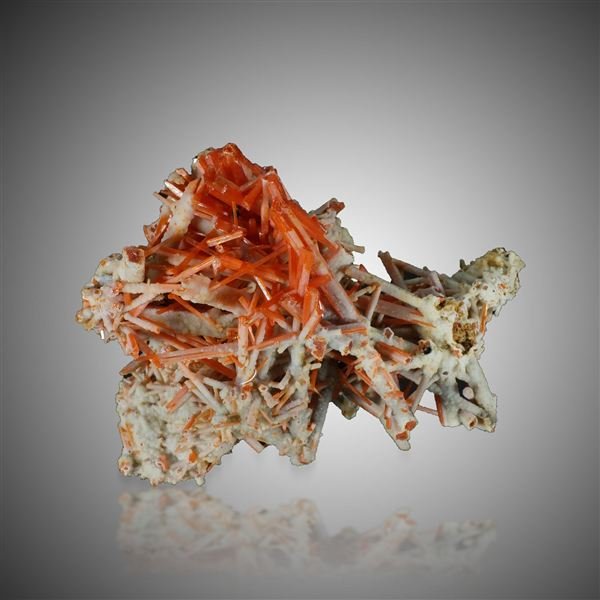
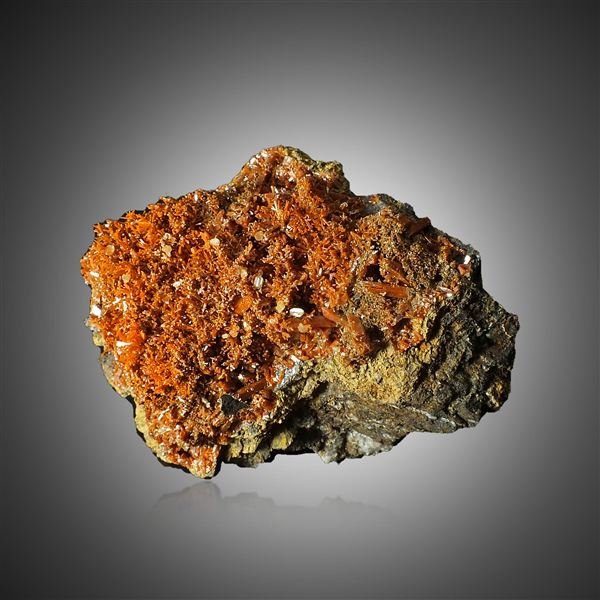
This note describes the Dundas field, its constituent mines and crocoite generally, using well-established public mineralogical and historical information about the district. It is not a claim about the specific collecting history of any individual specimen beyond what's recorded on that specimen's own page — in these cases, the Adelaide Mine and Kapi Mine localities and their recorded collection provenance already on file.