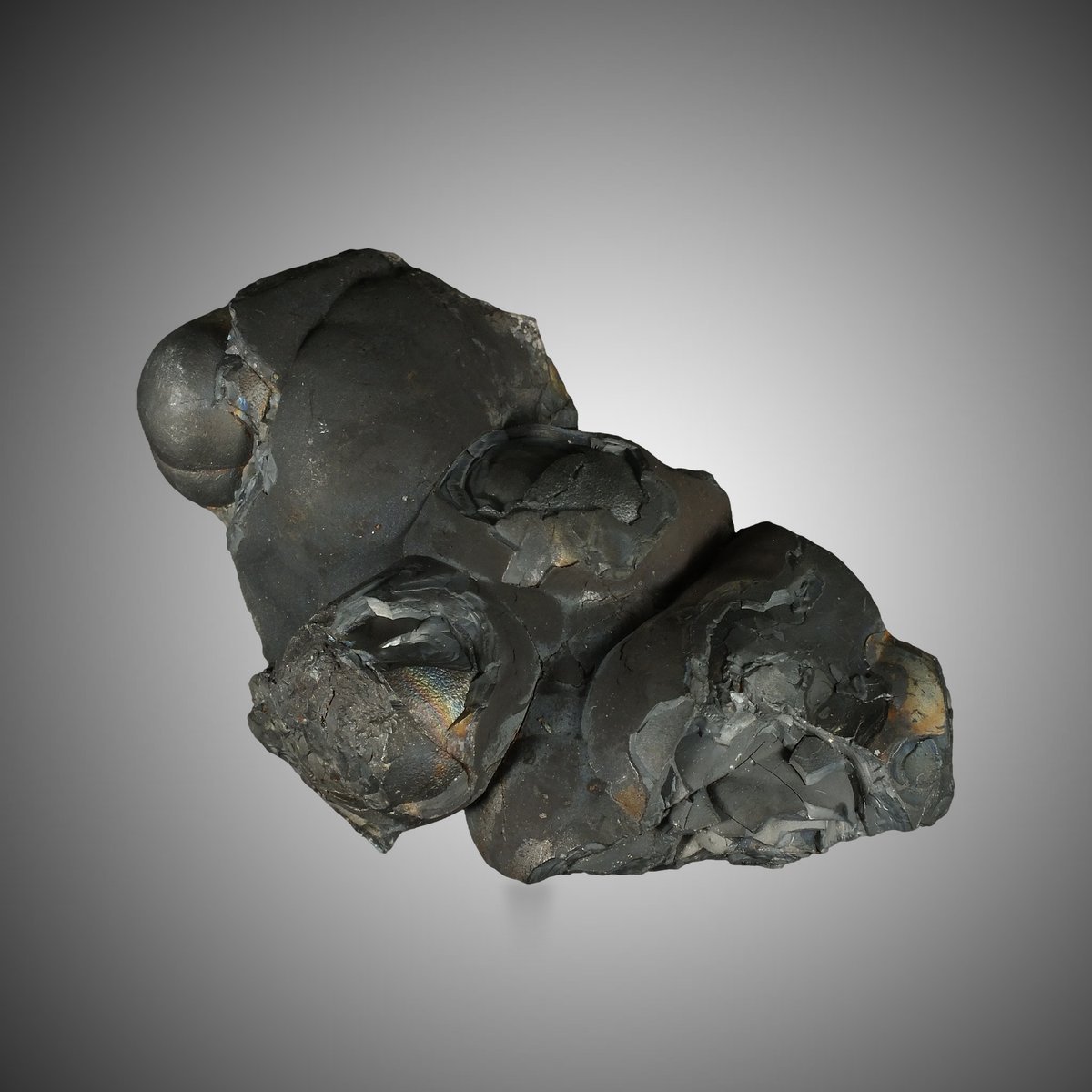


Coronadite
One of one. Pay securely by PayPal or direct bank deposit at checkout.
Coronadite from the South Mine, Broken Hill, New South Wales, Australia, measuring 73 × 43 × 34 mm and weighing 205 grams. A good-sized specimen of one of the lead-manganese oxides that help define Broken Hill's oxidised zone.
Coronadite is a lead manganese oxide of the hollandite group, Pb(Mn4+6Mn3+2)O16, and it usually forms dark grey to black botryoidal crusts, banded masses or fine fibrous growths rather than distinct crystals. It was named after Francisco Vásquez de Coronado, the sixteenth-century Spanish explorer of the American south-west, from its type locality in Arizona. It forms where lead and manganese are both released by weathering, which made Broken Hill an ideal setting: the original outcrop of the lode was a black, manganese-rich gossan.
That gossan is part of Broken Hill's founding story. When Charles Rasp pegged the outcrop in 1883 he reportedly thought it might be tin, and it turned out to be the top of one of the richest silver-lead-zinc deposits ever found. The South Mine worked the southern part of the lode for decades, and this Coronadite carries the names of two collections, David Vince and Ruth Coulsell, which adds a little history of its own.